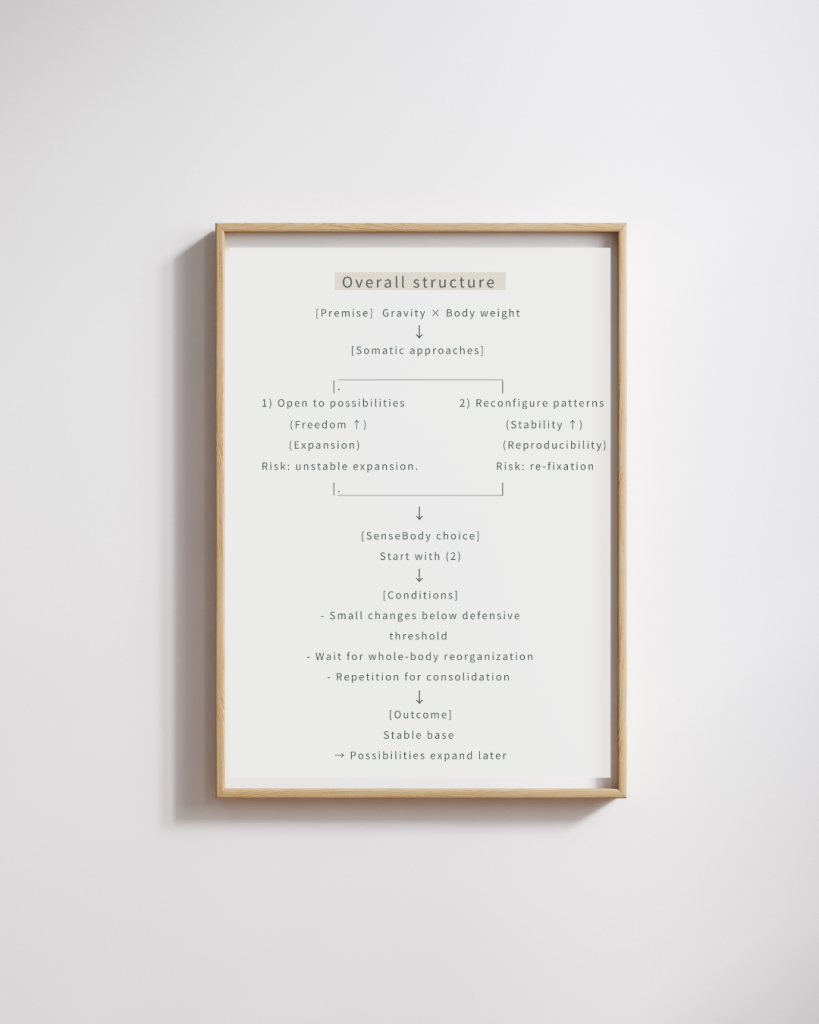
■Premise: Starting from Non-negotiable Conditions
Human movement occurs
within an environment governed by gravity,
in bodies that have weight.
These conditions do not change,
and will be taken as a starting point.
■Approach: Positioning of Somatic Work
In SenseBody,
somatic approaches to the nervous system are used
to influence posture, movement, and response patterns.
Within this framework,
somatic work appears to be applied in at least two distinct ways.
■Two Directions
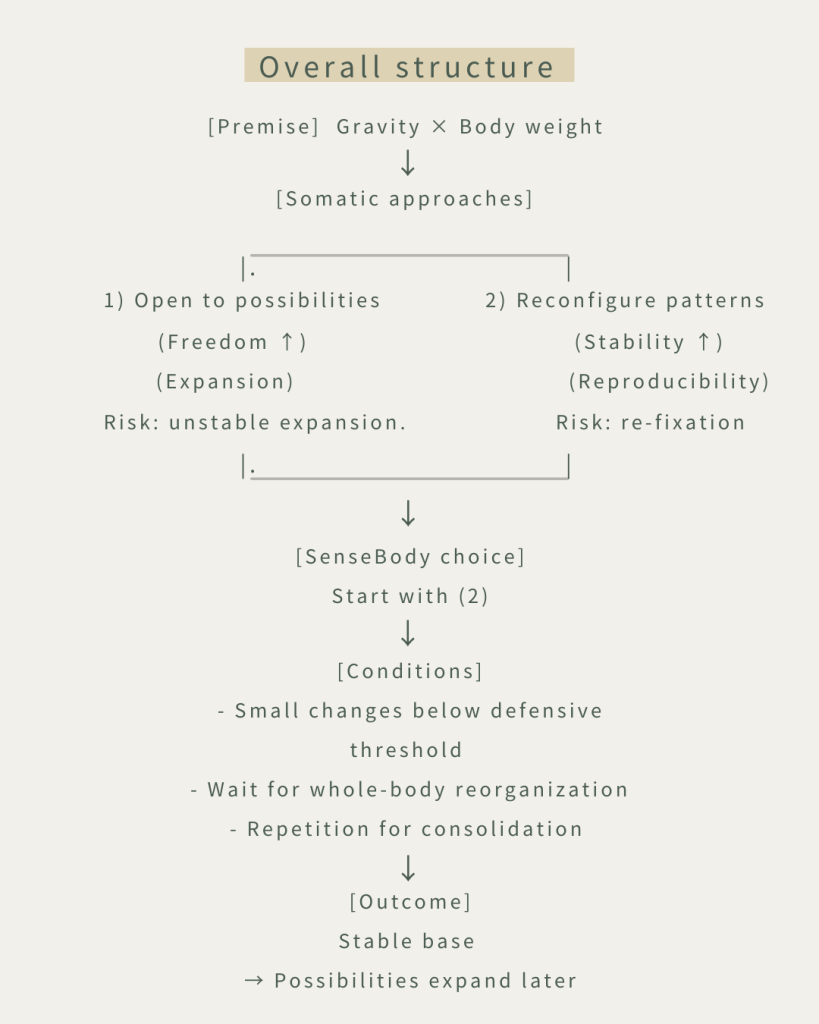
- Opening toward a wider range of bodily and psychological possibilities
- Organizing and reconfiguring existing patterns
■1) Opening Toward Possibilities
This direction may involve:
- Increased degrees of freedom
- Emergence of novel sensations, responses, and movements
Benefit: expansion of possibilities
Risk: expansion without sufficient stability
■2) Organizing and Reconfiguring Patterns
This direction may involve:
- Loosening previously fixed or destabilizing patterns
- Establishing an additional pattern
Benefit: increased stability and reproducibility
Risk: newly formed patterns may also become fixed
■Positioning: SenseBody’s Reference
Based on the initial premise,
SenseBody adopts the following reference:
“How smoothly can the system function
with minimal error or disruption?”
Accordingly,
priority is given to the reconfiguration approach (2).
The initial aim is to establish a condition in which
posture and response do not collapse excessively.
Furthermore,
states are not treated as targets to be directly controlled,
but as outcomes that emerge from specific conditions.
■Method: Conditions for Reconfiguration
To support the formation of an additional pattern,
it is necessary to consider the reality of
functioning in an upright position
under gravity and body weight.
This involves structuring conditions such as:
- Adjusting inputs to remain below the threshold
at which defensive responses arise - Allowing time for whole-body reorganization to occur
- Repeating this process to create opportunities
for reconfiguration
Repetition plays a key role
in stabilizing the newly formed organization.
To support reproducibility,
the state, position, and movement of bodily structures
are articulated in a form that can be revisited.
■Design Principle: Macro and Micro
At the macro level,
a clear reference is established.
At the micro level,
the system is allowed to respond.
■Conclusion: On Possibility
When a stable base is established,
possibilities tend to expand subsequently.
This is the working assumption.